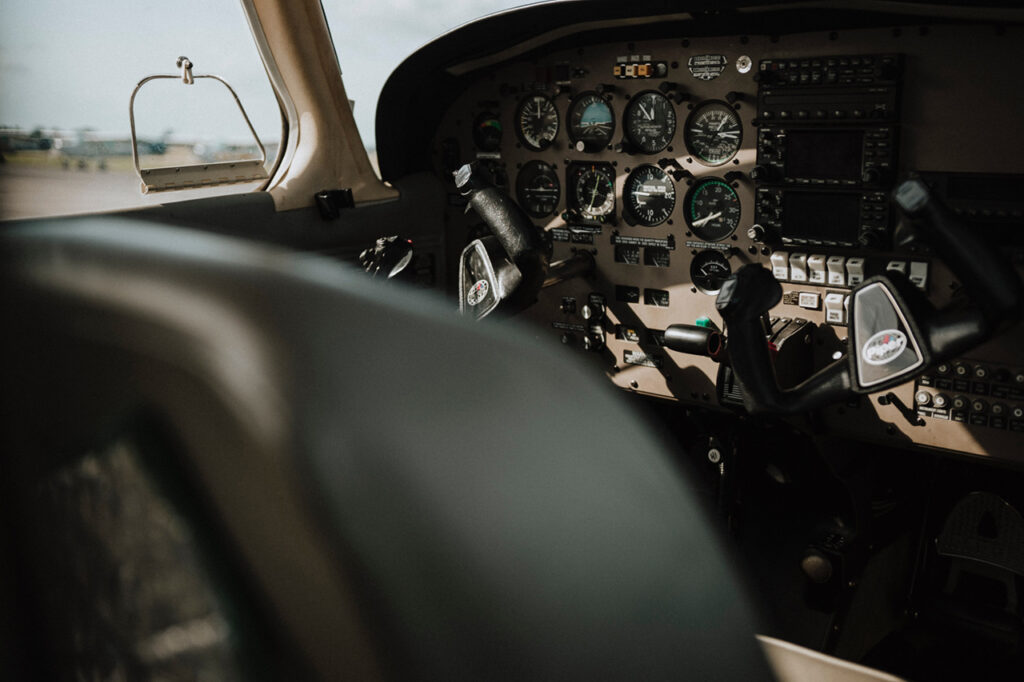

The question of how to become a pilot usually starts as an idea, but quickly turns into a concrete plan once the structure of training and the clearly defined development path become clear.
Modern aviation is one of the most dynamic industries, with a constant demand for new pilots. This means that the path to a professional career exists-but it requires a systematic approach, continuous training, and a clear understanding of each phase.
If you’re looking for a realistic and practical overview of how to become a pilot in Serbia or Europe, it’s essential to look at the entire process-from the first license to the level required to work for an airline.
Within Safe Sky Alliance, the complete pilot development program takes place at Ečka Airport, where candidates go through all stages of training-from beginner level to professional standard.
PPL(A) Training – The Starting Phase of Pilot Development
PPL(A), or Private Pilot Licence (Airplane), is the basic pilot license and the starting point of every pilot career.
During this phase, candidates acquire fundamental knowledge and skills required to independently operate an aircraft in non-commercial operations.
Training covers key areas such as aerodynamics, meteorology, navigation, aviation law, and radio communication.
The minimum regulatory requirement for PPL(A) is 45 flight hours, including both instructor-led and solo flights.
A particularly important milestone is the first solo flight, which marks the transition from supervised to independent aircraft operation.
At Ečka Airport, PPL(A) training is conducted through a clearly defined structure, where each segment plays a role in the candidate’s development.
CPL(A) Training – Transition to the Professional Level
After obtaining a PPL(A), the next step for candidates pursuing a professional career is CPL(A), or Commercial Pilot Licence (Airplane).
This phase represents the transition from recreational to professional flying.
To obtain a CPL(A), a minimum of 200 flight hours is required, along with advanced theoretical and practical training.
During this phase, candidates develop:
- precise aircraft control
- advanced navigation skills
- instrument flight capability
- multi-engine operations
- decision-making in complex operational conditions
CPL(A) allows a pilot to perform commercial operations and serves as the foundation for further progression toward the ATPL(A) level.
ATPL(A) Theory and the Path to an Airline Career
ATPL(A), or Airline Transport Pilot Licence (Airplane), is the highest level of pilot license in civil aviation.
In practice, most candidates first complete ATPL theory and obtain what is known as an ATPL(A) “frozen” status, which becomes fully active after meeting the required flight hours.
Theoretical training includes 14 complex subjects and represents the most demanding part of the entire process.
These subjects include:
- flight planning
- aircraft performance
- advanced meteorology
- navigation
- aviation law
The focus of this phase is not only on flying skills, but on understanding the entire operational system in which a pilot functions.
Alongside theory, candidates continue building flight hours and operational experience, leading to a First Officer position and eventually to Captain.
Pilot Development – From Basic Skills to Operational Responsibility
The journey from PPL(A) to ATPL(A) is not a series of isolated steps, but a continuous development process.
Throughout each phase, candidates build:
- technical flying skills
- risk assessment ability
- real-time decision-making
- operational discipline
These competencies form the foundation for safe and efficient performance in commercial aviation.
Is a Pilot Career a Realistic Choice?
A pilot career is not reserved for a predefined type of candidate.
Many pilots start training with no prior experience and come from diverse professional backgrounds.
The key factor is not previous knowledge, but the willingness to commit to a long-term process of learning and development.
The first step in that process is an introductory flight.
At Ečka Airport, through familiarization with training within Safe Sky Alliance, candidates gain a realistic insight into what a pilot career looks like.
Conclusion
The path to becoming a professional pilot is clearly defined.
It begins with PPL(A) training, continues through CPL(A), and leads to the ATPL(A) level and a career in an airline.
The process requires time, discipline, and dedication-but it is entirely achievable for candidates willing to go through it.