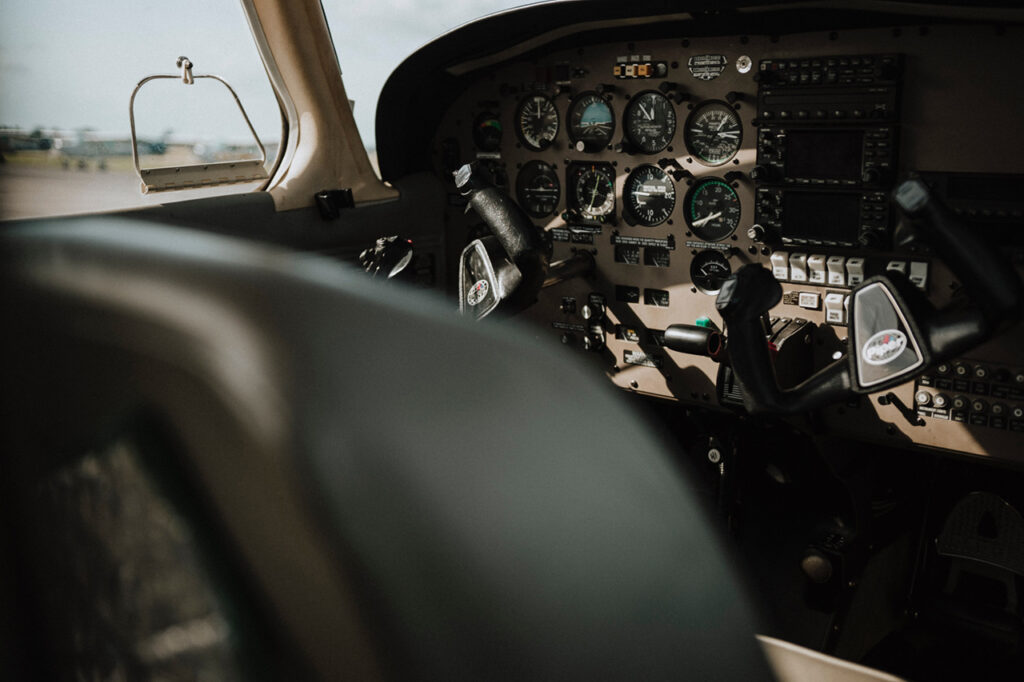

Flying an aircraft has never been just an idea for many people. It’s a question that keeps coming back: How do I become a pilot, and is it a realistic path?
Most people assume the process is complicated, expensive, or reserved for someone else. In practice, the path to your first pilot license is clearly defined, and every year a large number of candidates complete it with no prior experience.
Everything starts with one step: PPL(A) training.
Within Safe Sky Alliance, the complete PPL(A) training is conducted at Ečka Airport, where candidates go through a structured process-from their first flight to obtaining their license.
What is PPL(A) and Why It’s the Beginning of Everything
PPL(A), or Private Pilot Licence (Airplane), is the basic pilot license in civil aviation.
It allows a pilot to operate single-engine general aviation aircraft for non-commercial purposes, in accordance with visual flight rules.
PPL(A) is not just a license-it is the foundation of all pilot training.
During the training, candidates gain an understanding of the fundamental principles of flight through subjects such as aerodynamics, meteorology, navigation, aviation law, and communication with air traffic control.
However, the key outcome is not just theoretical knowledge, but the development of a pilot’s mindset and decision-making ability.
PPL(A) is the entry point for all further stages of training, including CPL(A) and ATPL(A).
Who Can Start Pilot Training
No prior aviation experience is required to begin PPL(A) training.
Most candidates start from zero.
Basic requirements include minimum age, a valid Class 2 medical certificate, and basic knowledge of English.
Pilots come from various backgrounds-students, engineers, IT professionals, entrepreneurs, and people looking for a career change.
What they all have in common is that they decided to begin the process.
Medical Examination – The Basic Requirement
Before starting training, you need to obtain a medical certificate.
The examination includes assessment of vision, hearing, general health, and basic functional abilities.
Requirements for the PPL(A) level are not restrictive, and most candidates pass without issues.
The goal is not perfection, but confirmation that the candidate can safely participate in flight operations.
Theoretical Training – The Foundation of Understanding Flight
Theoretical training forms the foundation of the entire process.
Candidates learn how an aircraft works, how to plan and prepare a flight, and how to assess conditions that affect safety.
The training includes approximately 100 to 120 hours and covers all key areas required for independent flying.
The focus is not just on memorizing information, but on understanding and applying knowledge in real situations.
Practical Training – Developing Skills in Real Conditions
Practical training is where theoretical knowledge comes to life.
Candidates go through basic and advanced maneuvers, takeoffs and landings, navigation flights, and emergency procedures.
The minimum regulatory requirement for PPL(A) is 45 flight hours.
The structure includes flights with an instructor and solo flights, with gradually increasing responsibility.
The most important moment in this phase is the first solo flight.
That’s the moment when the candidate flies the aircraft independently for the first time.
At Ečka Airport, training is conducted systematically, with each flight having a clear objective and contributing to the overall development of the pilot.
Final Exam – Proof of Competence
After completing both theoretical and practical training, the candidate takes the final exam.
The skill test includes flight planning, navigation, execution of maneuvers, and handling in-flight situations.
The goal is not just to test knowledge, but to confirm that the candidate is capable of safe, independent flying.
After successfully passing the exam, the candidate obtains the PPL(A) license.
How Long Does PPL(A) Training Take
The duration of training depends on the pace of flying and the candidate’s availability.
Intensive training can take between 3 and 6 months.
For candidates training alongside other commitments, the process may take longer.
The key factor is not speed, but consistency and quality of learning.
What Comes After the PPL(A) License
After obtaining a PPL(A), candidates can continue their development through additional ratings and advanced modules.
This includes night flying, instrument flying, and further steps toward a professional level.
For those aiming for an aviation career, the next step is CPL(A), followed by the ATPL(A) path.
What Aircraft Is Used for Training
Training within Safe Sky Alliance is conducted on aircraft such as the Cessna 172.
This type of aircraft is a global standard in pilot training due to its stability, reliability, and predictable flight characteristics.
How to Start Training
The most effective way to begin is with an introductory flight.
It’s an opportunity to get familiar with the training process, working methods, and the real environment in which training takes place.
At Ečka Airport, through the first flight within Safe Sky Alliance, candidates gain a clear understanding of what the beginning of a pilot career looks like.